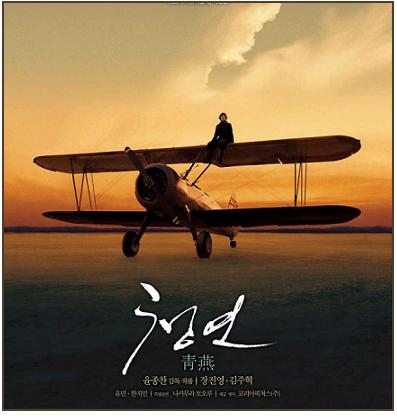
The movie “Blue Swallow” is based on a true
story about Park Kyung Won who is a female pilot during the Japanese
colonialism era in Korea. While I was watching this movie, two things came up in
my head such as modernization of women and pain of dualism. In the beginning of
the movie, young Kyung Won stands outside of the classroom and tries to learn
while other boys learn in the classroom. I realized that women’s role was
limited because they had to do their work inside of the house instead of
learning in the 1900s. However, Kyung Won wants to learn despite her father’s
opposition and gets accepted into a flight school. She does not stop to achieve
her dream, and she finally becomes a famous skillful pilot in her school by
winning at a Japanese flight competition. As Yoon’s reading mentions, “A new
type of Korean woman had begun to emerge” (P. 73) and Kyung Won becomes a role
model for women in Korea. Despite Kyung Won’s high achievement, she is not
welcomed in either side of Japan or Korea. Kyung Won’s last dream is a long
distance flight from Japan to a city called Chosun in Korea. She tries to get
some sponsors from Koreans who live in Japan, but they blame her for using
Japanese air planes, which shows Koreans hatred and hostility to Japan. Later, the
ministry of Japan forces Kyung Won to show her royalty of Japan in return for his
support for her dream of a long distance flight. I think that Kyung Won
hesitated a lot to become a traitor, and it is very sorrowful that she could
not fly with her nationality with all disrespectful attention from numerous Koreans.
This depicted the pain that Koreans had with ambiguous identity during this
period.
Finally, Kyung Won begins her long distance
flight to Chosun. In this scene, Kyung Won encounters bad weather, and I think
that the bad weather describes how Koreans are experiencing a hard time due to
the loss of their country and harassments from Japan. Also, this long distance
flight portrays how Kyung Won wants to get away from the Japanese interruption as
well as how she wants liberation from Japan.

What do you mean by "the pain of dualism"? That's very interesting phrase, and has a lot of resonances with the situation that Kyung-won faces (both in terms of ethnicity and gender), but it would be great to know what you mean, exactly.
ReplyDelete